
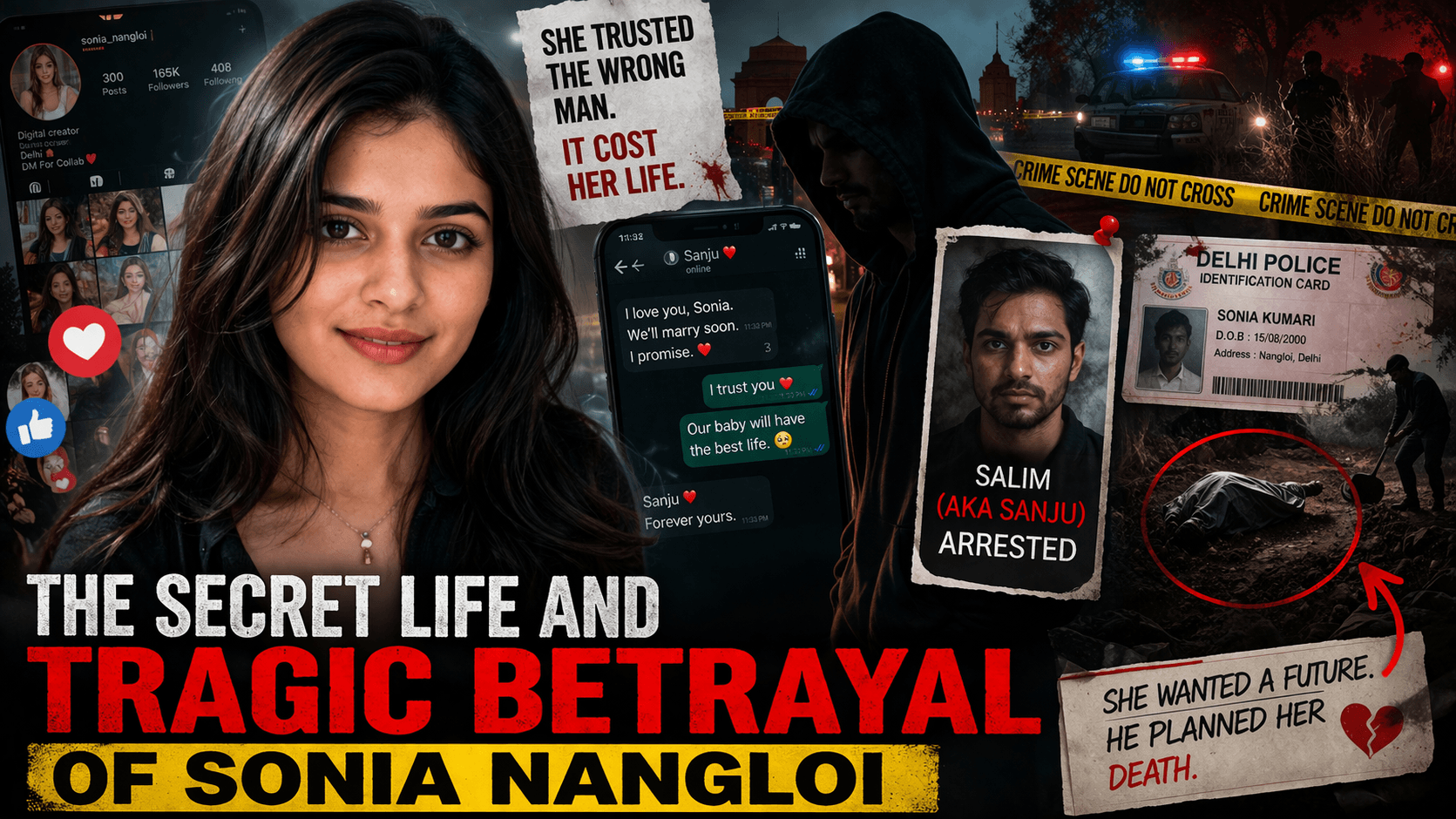
From Instagram Love to a Shallow Grave
At 4:00 a.m. on October 21st, 2024, 20-year-old Sonia Kumari packed her bags and slipped out of her family’s home into the pre-dawn hours. At the time of her disappearance, she was 7 months pregnant. Before she left, she told her sister her exact plan. She was walking out to build a permanent life with her boyfriend, completely separate from her family. When her mother woke up an hour later and found her gone, panic set in. Her frantic calls repeatedly went to voicemail until hours later, an
unidentified young man finally answered the phone. His message was blunt. He told the family to stop calling, claiming Sonia hated them and refused to speak. The family’s concern shifted to a direct threat that night. Sonia’s brother dialed the number again, and the same male voice answered. In the background, the brother distinctly heard the man tell someone nearby to dig the grave deeper. Terrified, the family rushed to the local police station to file a missing person’s report. The
police turned them away. In their eyes, two legal adults had simply eloped and the law had no reason to intervene. With the authorities standing down, Sonia was completely unreachable. Her family was left agonizing over the chilling audio, knowing a heavily pregnant woman was out there with a rapidly closing window of time. 2 days later, on October 23rd, officers at the Posham Vihar Police Station made what looked like a routine traffic stop. They pulled over a young man riding a motorcycle that had been
stripped of its license plates. When officers searched his pockets, they didn’t find his vehicle registration. They found official government ID cards belonging to Sonia and her father. To figure out who this man was and what he had done with Sonia, investigators had to look backward. They had to piece together the digital footprint of a boyfriend her family only knew by his strange nickname, Boot, the Hindi word for ghost. Those IDs shattered the elopment theory. Finding a missing woman’s identification in a stranger’s
pocket gave the police immediate physical evidence of a crime. Sonia grew up in Nanglo, a workingclass neighborhood in West Ali. Her parents were migrants from Bihar who survived on grueling manual labor. Her father sold animal fodder and her mother worked as a domestic helper. Forced to drop out of school after 10th grade due to money, she poured her limited savings into a smartphone. Her goal was clear. She would post content on Instagram, build a following as an influencer, and buy her family a real home. Right as she was
heavily investing in this online persona, a boy introduced himself as Sanju. He arrived at the exact moment she was seeking an audience and validation. She integrated him directly into her digital reality. Across her Instagram stories, she openly labeled Sanju as my hubby. She even observed carwatch, a rigorous fasting ritual meant for married Hindu women to prove her devotion to him online. Her drive to escape poverty pushed her to cury a life on social media. She built and fiercely defended a relationship online that
lacked concrete proof offline. Sanju saw what Sonia wanted and played the role specifically tailored to bypass her defenses. He used tangible props to anchor his lies. During their secret meetings, he wore a traditional Hindu kada bracelet on his wrist and placed a tika on his forehead to convince her they shared the same faith. The clock ran out on the performance when Sonia became 7 months pregnant. She gave him an ultimatum, demanding they formally marry and merge their lives in the real world. Cornered by his own fiction,
Sanju agreed. To keep her compliant, he told her they were going to drive to the city of Rotak to hold the wedding ceremony. The soon-to-be husband she showed off to her followers was entirely artificial. Every religious marker and romantic promise was a calculated mechanism designed for exploitation. On the morning of October 21st, Sanju arrived in a rented car to pick her up. He brought two friends, Pankage and Riddic, telling Sonia they were there to celebrate the wedding. As they drove down the highway between Bahadgar and
Roto, the mood soured. Sonia demanded guarantees about their commitment while Sanju continuously tried to stall the conversation. Late that night, they pulled off the road near the village of Medina. It was a desolate area 20 km away from their promised destination. There was no wedding. Sanju and his friends dragged the pregnant 20-year-old out of the car, assaulted her, and strangled her to death using a mobile phone charging cable. They dropped her body into a 4ft grave they dug on the spot. This was the exact moment her
brother had called. The background noise he heard over the phone was the sound of them burying her. She had packed her bags, believing she was stepping into a hard-earned future. Instead, she climbed into a car with a man who was chauffeering her to an execution. Once the police connected the traffic stop suspect to Sonia’s IDs, they began their interrogation. The man finally confessed his true identity. His name wasn’t Sanju, it was Sem. After burying Sonia, Sem didn’t just flee the physical scene.
He immediately went to work scrubbing his digital fingerprints. He logged into the Instagram account he used to communicate with her. In a few keystrokes, he changed his username from S. Sanju 17 to S. Salem 17. His online persona was the murder weapon. He used it to lure her in, maintain the deception for months, and then with a simple profile edit tried to erase his connection to her entirely. Sonia’s death exposes the physical risks of accepting a curated digital life as fact. Her desire to escape poverty
created a psychological blind spot, allowing a predator to feed her exactly what she wanted to see. Today, a convincing identity can be built with a few cheap props and an anonymous social media handle. Handing over blind trust to a digital profile can have lethal consequences. Verifying the person behind the screen is a basic survival tactic in an era where identity is as easy to change as a username.
Disclaimer – The Midnight Readers
All content on The Midnight Readers is for entertainment purposes only. Stories are fictional, dramatized, or based on unverified accounts and are not claimed to be real.
Reader discretion is advised, as some content may be disturbing. By reading, you agree to engage at your own risk.
👁️ Not every story ends when you stop reading.