A Stream That Continued After Death
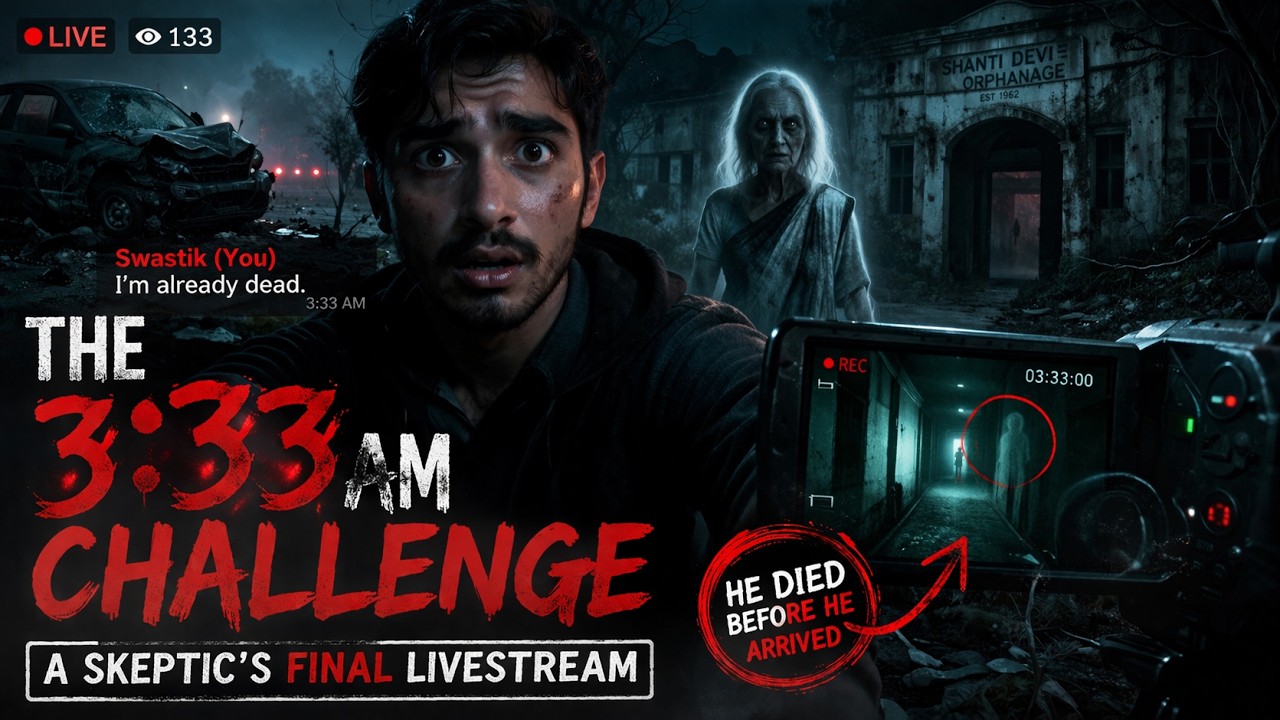
On a cold morning, police entered the burned out shell of an abandoned orphanage and found a camera lying on the floor. It was still recording, broadcasting a completely empty room to thousands of confused viewers. The camera belonged to a popular creator named Swastik, but according to official police records, Swastik never made it to the orphanage. At exactly 2:20 a.m., his SUV was crushed in a head-on collision with a truck on a highway outside the city. He died on impact. This map lays out a physical impossibility. We have a
confirmed fatal crash right here at 2:20 a.m. Yet server logs show that Swastik’s channel, The Night Hunter, initiated a live broadcast from the orphanage 20 km away 10 minutes later at 2:30 a.m. A man who died instantly in a shattered SUV cannot travel 20 km through a forest, unpack lighting equipment, place motion sensors, and cheerfully greet his subscribers. The server logs and the police report describe two different worlds. Reconciling them requires looking at the footage Swastik left
behind. Beginning with the moments he first arrived at the orphanage, swastik built a massive audience on a very specific premise, proving that the supernatural is a lie. He was an aggressive skeptic, a creator who actively hunted out supposedly haunted locations just to mock the local legends on camera. When he pushed open the rusted iron gates of the orphanage, his hands were full of cameras, lights, and environmental sensors. He was smiling. He had absolutely no idea his physical body was currently trapped inside a
wrecked car miles away. He wasn’t there for a genuine investigation. He was there because a subscriber suggested it. His entire routine, setting up equipment, cracking jokes, checking the live chat, was a performance calibrated for maximum views and engagement. Swastik continues this routine, checking his gear, and maintaining his skeptic persona, even while his physical body remains miles away in a highway wreck. The habits of a professional creator appear to have overridden his ability to
process his own termination. The environmental data captured on stream begins to contradict his reality almost immediately. At 2:55 a.m., a motion sensor in an adjacent room triggers. Swastik investigates, finds nothing, and laughs it off as a rat. This architectural diagram plots his sensor placements. At 3:00 a.m., devices in three separate rooms flash simultaneously. Instead of questioning this impossibility, Swastik blames the wind. Minutes later, a severe thermal anomaly occurs. The main hall’s
temperature crashes from 24° down to 16. A living person experiencing an 8° temperature drop would shiver or at least acknowledge the biting cold. Swastik doesn’t react physically at all. He just keeps reading his chat, seemingly detached from the biology of a living body. The denial holds until 3:20 a.m. when the physical environment forces itself into the frame. Heavy wooden dining chairs begin dragging across the floor entirely on their own. Swastik’s confidence finally starts to fracture. Look at this catastrophic
glitch. At exactly 3:33 a.m. The camera feed breaks down into static lines. And right there over Swastik’s shoulder is the faint image of an elderly woman with severe burn scars on her face. While the figure in the monitor is terrifying, a single line of text in the live chat is what truly fractured Swastik’s composure. A pinned notification appears from Swastik official, his own secured account, stating, “Account isn’t hacked. You are really dead.” He spent his life trusting data over his own senses, and
the truth finally arrived through his own digital ecosystem. A password protected comment provided the one piece of evidence he couldn’t rationalize away. The moment he reads that comment, the illusion collapses. Swastik looks down and realizes his feet are floating several inches above the ruined floorboard. He holds up his hands and they are fading, slowly becoming translucent. Psychologists often talk about phantom limb syndrome where a patient feels a missing arm or leg. This is a digital phantom limb. A creator’s
consciousness, so deeply addicted to the cycle of broadcasting and receiving attention, simply continues performing long after the body is gone. The old woman in the monitor steps forward as thick, terrifying shadows begin creeping across the concrete floor. She tells him, “These aren’t demons. These are the projections of his own deep-seated fears and his ultimate denial of reality.” She warns him that if he stays trapped in the sphere, he will never be free. She reaches out, grabs his fading hand, and
pulls his spirit away. The physical camera immediately plummets, hitting the ground with a loud crack. The live stream didn’t stop. For hours, thousands of viewers sat there typing in the chat, watching an empty, silent room, completely indifferent to the fact that the person they came to watch no longer existed. When our entire identity is tied to a screen, the metrics we chase can trap us. Our obsession with holding an audience’s attention might just be strong enough to keep our digital
footprint walking, talking, and streaming, turning us into the very ghosts we leave behind on the server.
Disclaimer – The Midnight Readers
All content on The Midnight Readers is for entertainment purposes only. Stories are fictional, dramatized, or based on unverified accounts and are not claimed to be real.
Reader discretion is advised, as some content may be disturbing. By reading, you agree to engage at your own risk.
👁️ Not every story ends when you stop reading.